Italy is making one of the most ambitious pushes for foreign labor in European history. With an aging population and persistent labor shortages across key industries, the Italian government has approved a sweeping three-year immigration decree that will grant 497,550 work permits to non-EU citizens between 2026 and 2028 . For workers seeking opportunities in Europe, this represents an unprecedented legal pathway to employment and residency.
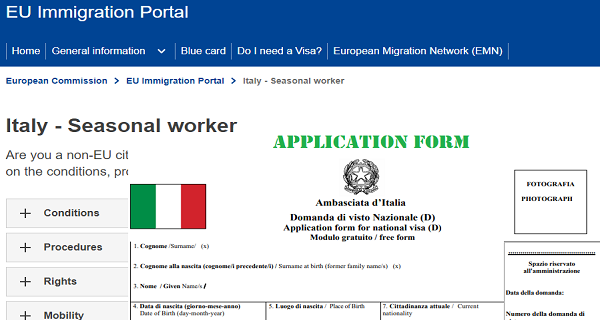
What Is the Decreto Flussi?
The Decreto Flussi (Flow Decree) is Italy’s annual quota system that governs how many non-EU workers can legally enter the country for employment . Rather than operating on a year-by-year basis, Italy has adopted a three-year planning approach for 2026–2028, providing greater predictability for both employers and prospective employees . The decree was officially published in the Italian Official Gazette on October 15, 2025, following approval from the Council of Ministers .
The International Organization for Migration (IOM) has praised this initiative as “not only a development win – it is a lifesaving measure,” noting that expanding regular migration channels helps protect workers from exploitation and irregular migration routes .
Annual Quotas for 2026–2028
The work permits are distributed across the three years as follows :
| Year | Total Work Permits |
|---|---|
| 2026 | 164,850 |
| 2027 | 165,850 |
| 2028 | 166,850 |
These permits are divided into two main categories: seasonal work (267,000 across the three years) and non-seasonal/self-employed work (230,550) . For 2026 specifically, the breakdown includes :
-
88,000 seasonal work permits – primarily for agriculture and tourism
-
76,200 non-seasonal subordinate work permits – for salaried employment across various sectors
-
650 self-employment permits – for entrepreneurs, freelancers, and start-up founders
-
Additional reserved quotas for stateless persons, refugees, and workers of Italian descent
Which Sectors Are Hiring?
Italy has identified specific industries facing critical labor shortages. Non-seasonal work permits are available for salaried employment in :
-
Manufacturing
-
Construction – demand expected to rise significantly due to Olympic-related infrastructure projects
-
Logistics and transport
-
Hospitality and tourism
-
Domestic work and family care – 13,600 permits reserved for this sector
-
Metalwork and mechanics
-
Agriculture and agri-food
For seasonal workers, the primary sectors are agriculture (harvesting, planting, farm work) and tourism (hotels, restaurants, summer resorts) .
Priority Countries and Reserved Quotas
Not all nationalities have equal access. Italy has established priority status for countries with migration cooperation agreements. The 2026 non-seasonal quota includes :
-
25,000 permits reserved for nationals of 40 designated “partner” countries, including Algeria, Bangladesh, Egypt, India, Morocco, Pakistan, Peru, Philippines, Senegal, Sri Lanka, Tunisia, and Ukraine
-
18,000 permits conditional on new bilateral migration agreements
-
300 permits for stateless persons and UN-recognized refugees
Workers from priority countries benefit from dedicated application windows and streamlined procedures.
Key Application Dates for 2026
Employers must submit work authorization applications through the ALI Portal of the Ministry of the Interior on specific “click days.” The schedule for 2026 is as follows :
| Date | Category |
|---|---|
| January 12, 2026 | Seasonal workers – agriculture sector |
| February 9, 2026 | Seasonal workers – tourism sector |
| February 16, 2026 | Non-seasonal workers from countries with migration cooperation agreements |
| February 18, 2026 | All other non-seasonal employees and family care workers |
A pre-filling phase for applications opened from October 23 to December 7, 2025, allowing employers to prepare their submissions in advance .
The Application Process: Step by Step
Securing an Italian work permit involves three distinct stages, with the employer taking the lead role :
Step 1: Nulla Osta (Work Authorization)
The Italian employer must submit a nulla osta application to the local Immigration Desk (Sportello Unico per l’Immigrazione). This application confirms that the role fits within the annual quotas and meets Italian labor standards. Processing times are approximately 20 days for seasonal workers and 60 days for non-seasonal workers .
Step 2: Entry Visa
Once the nulla osta is approved, the worker has six months to apply for a work visa at the Italian consulate in their country of residence . The visa allows entry into Italy but does not grant long-term stay rights.
Step 3: Residence Permit
After arriving in Italy, the worker must apply for a residence permit (permesso di soggiorno) within eight days. This permit serves as the ongoing proof of the right to work and reside in Italy .
Major Reforms: The “Single Permit” System
In a significant development, Italy has adopted the EU Single Permit Directive (2024/1233) , consolidating work authorization and residence permit applications into a single streamlined procedure . Key features include:
-
90-day maximum processing time – a substantial reduction from the previous six-month average
-
Unified digital platform – centralizing data sharing between the Ministries of Interior, Labor, and European Affairs
-
Real-time tracking – employers and workers can monitor application status
-
Job mobility – workers can change employers or sectors without restarting the entire process
-
Unemployment protection – up to three months of involuntary unemployment no longer triggers automatic permit revocation
This reform, adopted in first reading by the Council of Ministers on January 20, 2026, is expected to take full effect by mid-2026 .
Employer Requirements and Compliance
Italian law places significant responsibilities on employers sponsoring foreign workers. Key requirements include :
-
Italian legal presence – the employer must have a registered entity in Italy (branch, subsidiary, or host company)
-
Financial stability – proof of ability to pay salaries and social security contributions (minimum income threshold of €30,000 generally applies)
-
Labor market test – for non-seasonal roles, employers must verify that no suitable local or EU worker is available
-
Proper documentation – employment contracts must meet Italian labor standards
-
Accommodation – proof of suitable housing for the worker where required
Penalties for non-compliance have intensified since 2025, with fines reaching up to €50,000 for fraudulent applications .
Costs and Processing Times
Government Fees
-
Visa application fee: approximately €116 (subject to change)
-
Residence permit card: €40–100, plus administrative costs
Third-Party Service Costs
Professional services for work permit processing typically range from €2,500 to €5,000 for comprehensive support, depending on the complexity of the case and the service provider.
Processing Timelines
-
Nulla osta approval: 30–60 days
-
Consular visa processing: several weeks to months
-
Residence permit issuance: additional weeks or months
Processing times vary significantly by prefecture, with some regions taking two to six months for complete processing . The government has committed to fully digitalizing the immigration system by the third quarter of 2026 to reduce delays.
Warnings: Avoiding Fraud and Scams
A recent anti-trafficking report described 2024 as “the year of deception,” highlighting a sharp rise in fraud connected to Italy’s Flow Decree . Unscrupulous intermediaries have posed as agents or employers, demanding payment for applications and then disappearing. Key warnings:
-
Never pay individuals promising work permits – the employer submits applications, not third-party agents
-
Verify employer credentials – legitimate Italian employers will have proper business registration
-
Use authorized channels – all applications go through the official ALI Portal
Fraud cases accounted for 80 percent of exploitation cases handled by anti-trafficking hotlines, with victims primarily from Tunisia, Morocco, India, and Egypt .
Special Pathways: Self-Employment and Start-Ups
Italy offers 650 self-employment permits annually, with specific quotas for :
-
Entrepreneurs – investing at least €500,000 and creating at least three new jobs in Italy
-
Freelancers and independent contractors – practicing regulated professions or nationally recognized occupations
-
Start-up founders – launching innovative start-ups under specific conditions
-
Internationally renowned artists – hired by major Italian cultural institutions
Looking Ahead: Opportunities for Workers
For non-EU nationals seeking legal employment in Europe, Italy’s 2026–2028 Decreto Flussi represents a rare and substantial opportunity. With nearly half a million work permits available, the program addresses genuine labor shortages while providing structured, legal migration pathways.
Success, however, requires preparation. Prospective workers should :
-
Identify employers in target sectors
-
Ensure all documentation is complete and properly translated
-
Understand that applications are competitive and deadlines are strict
-
Work only with legitimate employers and official channels
As one immigration specialist noted, early coordination with employers and meticulous documentation remain critical for meeting project start dates and avoiding costly delays